How Recovery Is Changing for Soccer Players
From ice baths to oxygen chambers: what the research actually shows about the recovery tools elite footballers are adopting, and what's worth your time.

By Dr. Zeeshan Siddiqui | Founder, Cryo SubZero

This article is for general educational purposes only and does not constitute medical advice. Cryotherapy, hyperbaric oxygen therapy and related modalities are not suitable for everyone and carry contraindications, including but not limited to cardiovascular conditions, uncontrolled hypertension, pregnancy, claustrophobia and certain respiratory conditions. Always consult a qualified medical practitioner before beginning any new recovery or wellness protocol, particularly if you have an existing health condition or injury. Individual results vary and no outcome is guaranteed. Named athletes referenced in this article are cited for public, verifiable context regarding recovery technology adoption in professional sport; no endorsement of Cryo SubZero by any named individual is stated or implied.
Soccer has always been a game decided in the legs. What's changed is how much money and science now goes into what happens to those legs after the final whistle. A modern professional can play two matches inside four days, sometimes across two continents. Recovery is no longer a rest day. It's a discipline.
Why recovery has become its own performance discipline
The physical cost of a competitive match is well documented. Full physiological recovery after a high-intensity match can take up to 72 hours, a timeframe that often conflicts with congested fixture schedules and raises the risk of fatigue and injury. That gap between "the body needs three days" and "the calendar gives you two" is exactly why recovery technology has moved from a fringe interest to a core part of club medical departments. Over the last decade, researchers have tested a genuinely wide range of interventions in professional and academy footballers, including cold water immersion, whole-body cryotherapy, compression garments, massage, electrical stimulation and hyperbaric oxygen therapy. A wide range of recovery interventions for professional soccer players has been investigated, spanning cold-water immersion, foam rolling, cryotherapy, massage, compression therapy, electrical stimulation, nutritional supplementation and active or passive recovery protocols. The honest picture, though, is that a lot of this evidence still comes from lab-based tests that don't fully mirror match conditions.
"In plain terms: cold therapy has the most data behind it, HBOT has the most promising newer data, and neither is a magic fix on its own. The clubs getting this right are combining modalities rather than betting on one."
What the evidence actually shows
Cold-based recovery remains the most studied approach in football specifically. A 2026 systematic review looking at cryotherapy and compression therapy in football found measurable, if modest, benefits. Professional footballers demonstrated a 3.8% improvement in maximal voluntary contraction recovery with pneumatic compression, and another study found a creatine kinase reduction of 67 U/L with cryotherapy-based protocols, both markers used to track muscle damage and recovery status. Cold water immersion in particular has the deepest evidence base.Studies on soccer and rugby players show improved recovery of sprint times and jump height in the first 24 to 48 hours after a match, largely attributed to reduced inflammation, improved circulation on rewarming, and short-term pain relief. But it isn't a guaranteed win. One 2025 study following national-level soccer players found cold and hot water immersion were not more effective than a placebo for restoring physical performance or supporting training adaptations, a reminder that recovery response varies a lot between individuals and protocols. Hyperbaric oxygen therapy is the newer entrant, and the youth-level research is encouraging. A double-blind randomised controlled trial on elite youth players tested a single one-hour HBOT session after a full match. Twenty elite youth football players were randomly assigned to either an HBOT group or a control group, played a 90-minute match, then underwent either 60 minutes of HBOT or a placebo intervention to measure the effect on recovery and next-day performance. This kind of controlled, sport-specific trial is exactly what the recovery space needed and largely lacked until recently.
Why elite players are personally investing in it
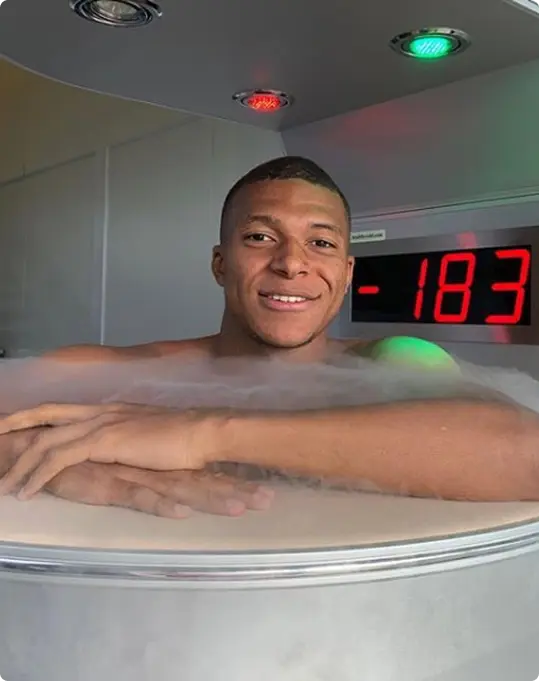
The clearest sign that recovery technology has gone mainstream in football is that players are buying their own equipment. CristianoRonaldo is the most visible example. He first used hyperbaric oxygen therapy in 2016 to speed recovery from a knee injury sustained in the Euro 2016 final, visiting a clinic in Ibiza for treatment. Years later, that early experience turned into a long-term habit. He installed a hyperbaric oxygen therapy chamber at his home in Cheshire, and reports since describe a custom, larger-than-standard chamber built into his home to support muscle recovery and overall physical condition. He isn't the only one. Industry reporting on hyperbaric adoption in professional sport notes that other elite athletes across football, tennis, basketball and American football have incorporated hyperbaric oxygen therapy into their recovery routines, viewing it as a long-term investment in career longevity rather than a one-off injury treatment. National federations have followed the same logic at a squad level, with recovery technology increasingly built into World Cup and tournament preparation rather than reserved for injury rehab. What matters here for readers: this is a genuine, verifiable pattern of professional athletes prioritising recovery infrastructure. It is not a suggestion that any specific player uses or endorses Cryo SubZero, and we won't imply that.
How this applies at Cryo SubZero
Our whole-body cryotherapy chamber runs down to −115°C for a 2 to 3 minute session, designed to fit into a training week without disrupting it, unlike a 10 to 15 minute ice bath protocol.For players managing a heavier fixture load or coming back from a knock, our dual-occupancy hyperbaric oxygen chamber means you don't have to go alone. It comfortably supports a parent alongside a junior athlete, or a support worker alongside an NDIS client, which matters for younger players whose recovery routine is still being shaped by the adults around them. We pair this with red light therapy and lymphatic drainage for players managing soft tissue load across a long season, with sessions overseen by a practising doctor on our clinical team.
The honest bottom line
Recovery technology in football has earned its place, but it earned it slowly and the evidence is still uneven. Cold therapy has the strongest track record for short-term performance markers like sprint and jump recovery, though at least one solid study found it performs no better than placebo for longer-term training adaptation. HBOT has newer, well-designed trials behind it and a growing list of elite players and squads using it, but it's not a therapy you should approach casually given the medical screening involved. If you're weighing these up for yourself, the honest answer is that consistency and correct timing matter more than which single therapy you pick. Speak to a clinician about your training block, your goals and your health history before building a routine around any of it.
References
- The Role of Cryotherapy and Compression Therapy in Improving Football Players Recovery: A Systematic Review. German Journal of Sports Medicine, 2026. DOI:10.5960/dzsm.2025.652
- Efficacy of post-exercise recovery strategies for elite soccer players: a network meta-analysis. Frontiers in Physiology, 2026. DOI: 10.3389/fphys.2026.1760392
- Gušić M, Stantić T, Lazić A, et al. Effects of hyperbaric oxygen therapy on recovery after a football match in young players: a double-blind randomized controlled trial. Frontiers in Physiology, 2024;15. DOI: 10.3389/fphys.2024.1483142
- Alexander J, Keegan J, Reedy A, Rhodes D. Effects of contemporary cryocompression on post-training performance in elite academy footballers. Biology of Sport, 2022;39(1):11-17. DOI: 10.5114/biolsport.2022.102866
- Gustafsson J, Montiel-Rojas D, Romare MGA, et al. Cold- and hot-water immersion are not more effective than placebo for the recovery of physical performance and training adaptations in national level soccer players. European Journal of Applied Physiology, 2025;125:3179-3194.
- Football Recovery Breakthrough: Hyperbaric Chamber Athletes Show Superior Muscle Healing. Sports Medicine Weekly, 2025. sportsmedicineweekly.com
- Cristiano Ronaldo undergoes 'HBO' in bid to overcome knee injury. ESPN, 2016. espn.com
- Cristiano Ronaldo installs high-tech oxygen chamber in his home to help improve fitness levels. SportBible, 2022. sportbible.com
- Cristiano Ronaldo & his special capsule recovery machine. RTOMedium, 2025. rtomedium.com
- 8 Professional Athletes Who Swear by Hyperbaric Chambers. Oxygen Health Systems, 2025. oxygenhealthsystems.com