IV Vitamin Therapy: What the Evidence Actually Shows
By Dr Aftab Samdani, Clinical Oversight | November 04, 2026 | 5 min read

This article is for general educational purposes only and does not constitute medical advice, diagnosis, or treatment. IV infusion therapy is an invasive medical procedure with individual risks and contraindications. Always disclose your full medical history and current medications to a qualified clinician before undergoing any infusion therapy, and consult your doctor if you have kidney disease, heart failure, G6PD deficiency, or any other pre-existing health condition. Cryo SubZero content is prepared under the clinical oversight of Dr Aftab Samdani and does not claim to treat, cure, or prevent any disease.
Drip bars are opening across every capital city and the claims keep getting bigger. Here is what the research, the regulators, and clinical practice actually support, and where the marketing has run ahead of the science.
Quick Answer
IV vitamin therapy works well for what it was originally designed to do: correcting a documented deficiency or replacing fluids and electrolytes faster than the gut can absorb them. For general wellness claims in healthy people, such as boosted immunity, anti-aging, or hangover cures, the evidence is thin to absent, and Australian regulators have repeatedly warned clinics against overstating what a drip can do.
What an IV infusion is actually doing in your body
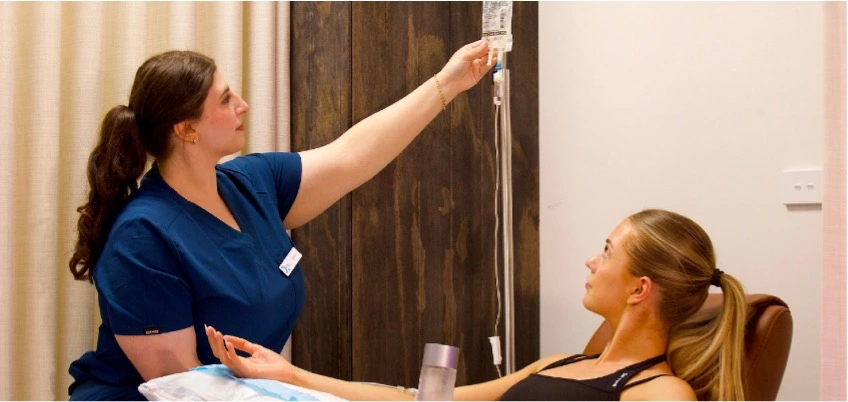
An intravenous infusion delivers fluid, electrolytes, vitamins, or minerals directly into the bloodstream through a small cannula, bypassing the digestive system entirely. That single mechanical fact is the whole basis of every claim made about IV Vitamin Therapy, and it is genuinely true: nutrients given intravenously reach the blood at close to 100 percent, while nutrients taken orally are filtered through gut absorption, which caps how much of certain compounds, particularly vitamin C and B vitamins, the body can actually take up at once. That is a real pharmacological advantage in specific situations. It is not, on its own, evidence that flooding a healthy, well-nourished person with extra vitamins produces a health benefit. The body's excess-handling systems, mainly the kidneys, are very good at excreting water-soluble vitamins it does not need. More is not automatically better, and in a few cases, more is worse.
Where the evidence is solid, and where it thins out
This is the part most marketing skips, so we are going to be blunt about it. The clinical literature on IV micronutrient therapy splits cleanly into two categories: correcting a real, measurable deficit, and everything else.
| Use case | Evidence strength | What the research shows |
|---|---|---|
| Rehydration and electrolyte correction in genuine dehydration | Established | Standard, well-studied medical practice when fluid loss is clinically significant. |
| Correcting a diagnosed deficiency (e.g. B12, iron, confirmed malabsorption) | Established | Well supported when a blood test confirms the deficiency first. |
| High-dose IV vitamin C in critically ill hospital patients | Context-specific | A 2023 systematic review and meta-analysis found a possible mortality benefit from vitamin C monotherapy in critically ill patients, though the certainty of evidence was rated low and the setting is intensive care, not a wellness lounge.1 |
| Myers’ Cocktail for fibromyalgia or chronic fatigue | Mixed / weak | The best-controlled trial, a 2009 randomised, placebo-controlled pilot from Yale, found both the active infusion group and the saline placebo group improved by a similar amount over eight weeks.2 That is a textbook placebo response, not proof the vitamin blend itself is doing the work. |
| Hangover relief beyond basic rehydration | Weak / anecdotal | Fluids help with dehydration related symptoms, but IV delivery has not been shown to outperform oral rehydration for hangover recovery, and it does nothing to speed up how the liver clears alcohol.3 |
The honest summary: IV therapy is a delivery method, not a treatment in itself. Its value depends entirely on what is being delivered, to whom, and why.
Why every capital city suddenly has a drip bar
This is not a fringe trend. The elective wellness segment of the Australian IV and injectable market is growing at roughly 12 to 15 percent a year, well ahead of the clinical hospital segment, driven by social media exposure, an expanding network of recovery and performance clinics, and rising consumer comfort with paying out of pocket for convenience-based health services. Athletes, touring musicians, and executives managing jet lag have been early and vocal adopters, which has done more to normalise the category than any clinical trial has. Public interest in a treatment is a signal that people want convenience and are willing to pay for it. It is not, by itself, evidence that the treatment delivers what it promises, and we are careful not to conflate the two in anything we publish.
The regulatory reality in Australia
In late 2022, the Australian Health Practitioner Regulation Agency wrote formal warnings to multiple clinics over IV infusion advertising, stating plainly that the medical justification and scientific evidence for them has not kept pace with their marketing. The Therapeutic Goods Administration followed with dedicated advertising guidance for IV vitamin businesses in December 2023, restricting claims of curing, treating, or preventing disease unless there is approved evidence behind them. Under Australia's National Law, advertising a regulated health service also cannot use client testimonials or create an unreasonable expectation of benefit, penalties that now run into tens of thousands of dollars per breach.
Who should not get an IV infusion
Because this is an invasive procedure, a proper intake matters more than the vitamin blend itself. IV vitamin and mineral therapy is generally avoided or requires medical clearance for people with: • Kidney disease or impaired renal function, since high-dose vitamin C and mineral loads are cleared through the kidneys • Glucose-6-phosphate dehydrogenase (G6PD) deficiency, which can trigger haemolysis with high-dose vitamin C • Heart failure or fluid-restriction conditions, where added volume can precipitate fluid overload • Elevated calcium or magnesium levels, or use of digoxin, due to interaction risk with Myers'-style formulas • Known allergy or hypersensitivity to any infusion component • Pregnancy, without prior medical clearance Even in people without these conditions, every needle insertion carries a small, genuine risk of infection, bruising, phlebitis, or, rarely, an allergic reaction. That is not a reason to avoid the treatment when it is clinically indicated, but it is a reason to be sceptical of anyone offering it as a casual, no-questions-asked add-on.

How Cryo SubZero approaches IV infusion therapy
We offer IV infusion therapy because, done properly, it has a genuine place in recovery and deficiency correction. We do not offer it as a cure for hangovers, a shortcut to anti-aging, or a substitute for a proper diagnostic workup, and we will say so directly if that is what someone is hoping to buy.
What that looks like in practice
• Clinical oversight from Dr Aftab Samdani, with every client screened for the contraindications above before infusion • No formula is marketed against a specific disease, diagnosis, or unproven outcome, in line with AHPRA and TGA advertising rules • Where a client suspects a genuine deficiency (fatigue, low iron, low B12), we recommend confirming it through our biomarker blood panel first, so the infusion is targeted rather than guessed at • Infusions sit alongside, not instead of, our other recovery modalities, cryotherapy, HBOT, and lymphatic drainage, as part of a broader recovery protocol rather than a stand-alone quick fix
The honest bottom line
IV vitamin therapy is neither the miracle cure the marketing often implies nor the complete scam some critics claim. It is a legitimate medical delivery method with a narrow, well-supported use case, correcting real, measurable deficiencies and fluid loss, and a much larger halo of wellness claims sitting on top of it that the evidence does not yet support. If you are considering it, ask what specifically you are being treated for, whether that has been confirmed rather than assumed, and whether the clinic can point to actual clinical evidence rather than testimonials. Any provider who cannot answer those questions plainly is not one we would recommend using.
Frequently asked questions
Q1. Does IV vitamin therapy actually work?
For correcting a confirmed deficiency or genuine dehydration, yes, it is effective and well established in medicine. For general wellness claims in healthy people, such as immunity, energy, or anti-aging, the evidence is weak or absent.
Q2. Can an IV drip cure a hangover?
No. It can rehydrate you and ease some dehydration-related symptoms, but it does not speed up how your liver processes alcohol, and controlled evidence has not shown it outperforms drinking water.
Q3. Is IV vitamin therapy safe?
It is generally safe when administered by qualified clinicians after proper screening, but it carries the same small risks as any needle based procedure, and high doses of certain vitamins can be harmful in people with kidney disease, G6PD deficiency, or heart failure.
Q4. How often can you get an IV infusion?
There is no universal answer. Frequency should be based on an actual clinical need, not a fixed schedule, which is why we recommend confirming any suspected deficiency with blood testing before booking regular sessions.
Q5. Why has AHPRA warned clinics about IV therapy advertising?
Because many clinics were marketing infusions as treatments for conditions like fatigue, immunity, and aging without the clinical evidence to back those specific claims, which breaches Australia's health advertising laws.
Book your first session
Level 1, 284 Bay Road, Cheltenham VIC 3192. Questions before you book? Call 03 9022 6606.
Book at Cryo SubZeroReferences
- Zhang B, et al. Intravenous vitamin C monotherapy in critically ill patients: a systematic review and meta-analysis of randomized controlled trials with trial sequential analysis. Ann Intensive Care. 2023. PMC9990974
- Ali A, Njike VY, Northrup V, et al. Intravenous micronutrient therapy (Myers' Cocktail) for fibromyalgia: a randomized, double-blind, placebo-controlled pilot study. J Altern Complement Med. 2009. PubMed 19250003
- Hackensack Meridian Health. Does IV Hydration Cure Hangovers? 2021. hackensackmeridianhealth.org
- Australian Health Practitioner Regulation Agency. Regulator issues warnings over unproven IV treatments. 23 November 2022. ahpra.gov.au
- Therapeutic Goods Administration. Advertising guidance for businesses involved with intravenous (IV) vitamin and related therapies, V1.0. December 2023. tga.gov.au
- IndexBox. Australia Vitamins and Minerals Based Injectables Market Analysis, 2026. indexbox.io
- Merck Manual, Professional Edition. Intravenous Vitamin Therapy (Myers' Cocktail). merckmanuals.com
- MD Anderson Cancer Center. IV vitamin therapy: Is it safe to use during chemo? 2025. mdanderson.org