Cryotherapy vs Ice Baths: What’s the Difference and Which Should You Choose?
By Dr. Zeeshan Siddiqui, Cryo SubZero, Cheltenham VIC · 7 minute read
Ice baths have been the default recovery tool for decades. Whole body cryotherapy is the newer option, with a chamber, a very different kind of cold and a much shorter session. If you train around Cheltenham, Bayside or greater Melbourne, you have probably wondered whether a chamber is worth it when a tub of ice at home does a similar job. The honest answer is that they are not the same thing, and neither is the clear winner for everyone. Here is how they differ, what the research actually says and how to choose.
Quick answer
Ice baths immerse you in 10 to 15°C water for 10 to 15 minutes, while whole body cryotherapy exposes you to dry air at -110°C for two to three minutes. Ice baths have stronger evidence for easing muscle soreness. Cryotherapy is faster and drier, but its evidence is weaker.
What is an ice bath?
An ice bath, or cold water immersion, means sitting in water cooler than 15°C for several minutes. Most protocols use 10 to 15°C for 10 to 15 minutes, with the water up to your waist or chest. Water pulls heat from your body quickly. It is cheap, easy to set up and has the largest body of research of any cold recovery method. The downside is obvious to anyone who has done one: it is wet, uncomfortable and takes time to set up and pack down.
What is whole body cryotherapy?
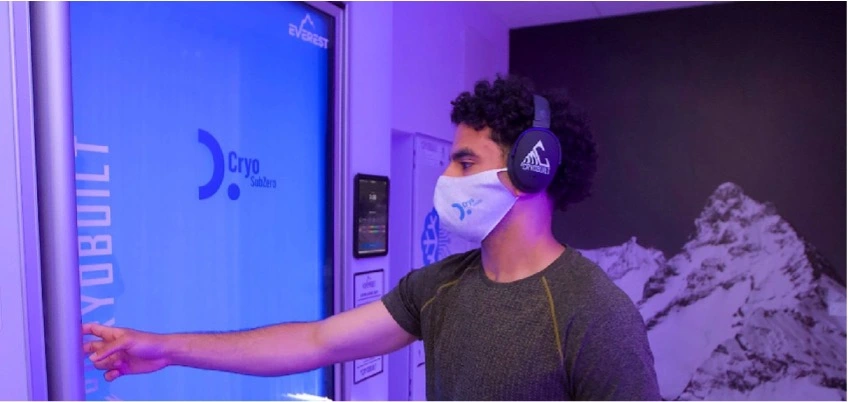
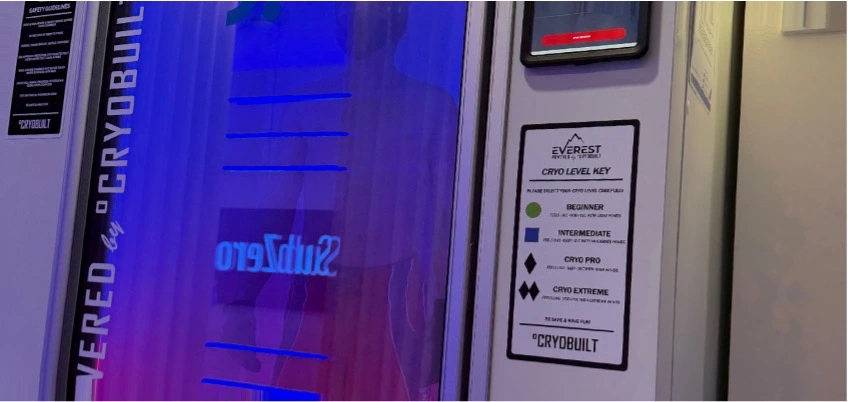
Whole body cryotherapy uses very cold, dry air instead of water. At Cryo SubZero the chamber runs at -110°C and a session lasts two to three minutes. You wear minimal clothing with protection for your hands and feet, and you stay on your feet in the chamber. Because the air is dry, you step out dry. Most people are warm again within minutes and back to their day. That convenience is the main practical difference, and it matters for people who train before work or squeeze recovery between sessions.
Cryotherapy vs ice bath at a glance
| Feature | Ice bath | Whole body cryotherapy |
|---|---|---|
| Cold source | Water, usually 10 to 15°C | Dry air at -110°C |
| Time in the cold | 10 to 15 minutes | 2 to 3 minutes |
| Wet and messy | Yes | No |
| Evidence for soreness | Stronger, though trials are small | Limited and mixed |
| Cost | Low, especially at home | Higher per session |
| Supervision | Usually none at home | Staff-supervised and screened |
What does the research say about ice baths?
A Cochrane review pooled 17 small trials with 366 participants. It found some evidence that cold water immersion lowers muscle soreness at 24, 48, 72 and even 96 hours after exercise, compared with rest. The authors rated study quality as low. A later meta-analysis of 27 articles reached a similar conclusion. Cooling, and cold water immersion in particular, reduced soreness for up to 96 hours. It found no clear effect on objective recovery markers. In plain terms, ice baths probably make you feel better after hard sessions. Whether they make you recover faster in a measurable way is less certain.
What does the research say about cryotherapy?
This is where we stay honest. A Cochrane review of whole body cryotherapy found four small laboratory trials with 64 participants, mostly young men. It concluded there was insufficient evidence to say whether it reduces soreness or improves recovery. The authors also called for better reporting of adverse events. A broader review of 16 studies was more encouraging. Muscle pain was lower after cryotherapy in 80% of them, and repeated exposures looked more consistent than single sessions. The authors still described their recommendations as preliminary, because temperatures, timing and protocols varied so much. So cryotherapy has promising signals, but it has not earned the same weight of evidence as ice baths for soreness. Anyone who tells you otherwise is overselling it.
The catch for people who lift
This is the part most recovery articles skip. In a 12-week study, men who sat in 10°C water for 10 minutes after strength sessions gained less muscle mass and strength than those who did active recovery. Muscle samples suggested the cold dampened the signals that drive muscle growth. That study tested ice baths, not air-based cryotherapy, and the two have not been compared in the same way. We would not assume cryotherapy is harmless or harmful on this point. If building muscle is your main goal, use cold sparingly straight after heavy lifting, whichever method you choose. For runners, cyclists and team sport athletes, it is less of a concern.
Safety and who should check first
Cold water has real risks. Sudden immersion triggers a cold shock response, with gasping and a spike in heart rate and blood pressure. That response peaks in water around 10 to 15°C and is strongest in the first 30 seconds. Researchers have linked cold water immersion with cardiac events in people who are vulnerable. Do not do an ice bath alone if you have any heart concerns, and get in gradually. Cryotherapy is short, supervised and screened, but it is not for everyone. Heart conditions, high blood pressure, pregnancy and cold-related conditions such as Raynaud’s or cold urticaria need a conversation with your doctor before either option.
Which should you choose?
An ice bath makes sense if you are on a tight budget, you are comfortable at home with someone nearby, or you are playing back-to-back games and want the option with the most research behind it for soreness. Whole body cryotherapy makes sense if time is your bottleneck, you dislike being wet and shivering afterwards, or you want a supervised, repeatable routine that takes under ten minutes door to door. You should be comfortable with the fact that the evidence is still developing. Be cautious with either if you are in a muscle-building phase, or you have a heart or circulation condition. Whichever you pick, cold is an add-on. Sleep, food, sensible training load and rest days do far more for recovery than any chamber or tub.
Book your first session
Level 1, 284 Bay Road, Cheltenham VIC 3192. Questions before you book? Call 03 9022 6606.
Book at Cryo SubZeroFrequently asked questions
Is cryotherapy better than an ice bath?
Not on current evidence. Ice baths have more research for soreness. Cryotherapy is quicker and dry, but its evidence is limited and mixed.
How cold is whole body cryotherapy?
Our chamber runs at -110°C. A session is two to three minutes in dry air.
Can ice baths affect muscle growth?
Possibly. Regular cold water immersion after strength training reduced gains in one 12-week trial, so be sparing if hypertrophy is your goal.
Is whole body cryotherapy safe?
It is supervised and screened, but some conditions rule it out or need medical advice first. We ask about your health before your first session.
Should I do both?
There is little research on combining them, so there is no strong reason to stack them. Choose the one that fits your training and budget.

Medical disclaimer: This article is general information only and is not medical advice. It does not take your personal circumstances into account. Cold exposure is not a treatment or cure for any condition, and results vary between people. Speak with your GP or treating health professional before starting any new recovery therapy, especially if you have a medical condition, take medication or are pregnant.
References
- Bleakley C, et al. Cold-water immersion (cryotherapy) for preventing and treating muscle soreness after exercise. Cochrane Database Syst Rev. 2012. doi.org/10.1002/14651858.CD008262.pub2
- Hohenauer E, et al. The effect of post-exercise cryotherapy on recovery characteristics: a systematic review and meta-analysis. PLoS One. 2015;10(9):e0139028. doi.org/10.1371/journal.pone.0139028
- Costello JT, et al. Whole-body cryotherapy (extreme cold air exposure) for preventing and treating muscle soreness after exercise in adults. Cochrane Database Syst Rev. 2015. doi.org/10.1002/14651858.CD010789.pub2
- Rose C, et al. Whole-body cryotherapy as a recovery technique after exercise: a review of the literature. Int J Sports Med. 2017;38(14):1049-1060. doi.org/10.1055/s-0043-114861
- Roberts LA, et al. Post-exercise cold water immersion attenuates acute anabolic signalling and long-term adaptations in muscle to strength training. J Physiol. 2015;593(18):4285-4301. doi.org/10.1113/JP270570
- Tipton MJ, et al. Cold water immersion: kill or cure? Exp Physiol. 2017;102(11):1335-1355. doi.org/10.1113/EP086283