Compression Boots for Recovery: Do They Work and What Should You Expect?
By Dr. Zeeshan Siddiqui, Founder, Cryo SubZero · 12 November 2026 · 6 min read
It is Thursday night after a heavy week. You ran intervals on Tuesday, did leg day on Wednesday, and your legs feel like wet sand. A mate mentions compression boots. You wonder if they are worth the time and money.
Do compression boots work for recovery?
Compression boots may modestly reduce how sore your legs feel after hard exercise, but evidence for faster strength recovery or better next-day performance is limited and inconsistent. Reviews of controlled trials find small benefits for soreness and little consistent effect on performance. They are an optional comfort tool, not a replacement for sleep, food and sensible training load.
How compression boots work
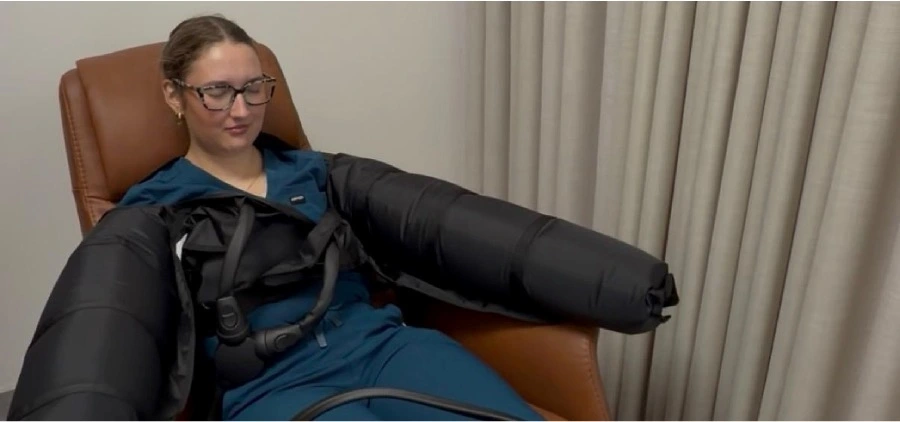
Compression boots are leg sleeves with several inflatable chambers. A pump fills the chambers one after another, usually from the feet towards the thigh, then releases the pressure. Researchers call this intermittent pneumatic compression, or IPC. The proposed idea is that the squeeze and release pattern helps move blood and fluid out of the legs, which could ease heaviness and swelling. That is a mechanism, not a proven outcome. Trials have not shown a consistent effect on muscle damage markers. What they have measured is how people feel and perform afterwards.
Compression boots, socks, manual drainage and lymphoedema care are different things
These terms get mixed up, and the research on one does not transfer to another.
| Option | What it is | Who delivers it | Main use |
|---|---|---|---|
| Compression boots (IPC) | Pump and inflatable chambers that squeeze in sequence | Device, set up by staff or yourself | Recreational recovery. Medical versions also exist |
| Compression socks and garments | Fitted elastic fabric with no pump | You wear them | Support during or after exercise, travel, medical use |
| Manual lymphatic drainage | Light, rhythmic hands-on technique | Trained practitioner | Often one part of lymphoedema care |
| Clinical lymphoedema treatment | Individual plan that can include fitted compression, exercise, skin care, manual drainage or a pump | Qualified lymphoedema practitioner | Managing diagnosed lymphoedema |
The RACGP lymphoedema guide describes compression for that condition as individually prescribed and fitted by a qualified practitioner. A wellness session is not that, and results from lymphoedema care should not be assumed for a post-training session.
What Cryo SubZero actually offers
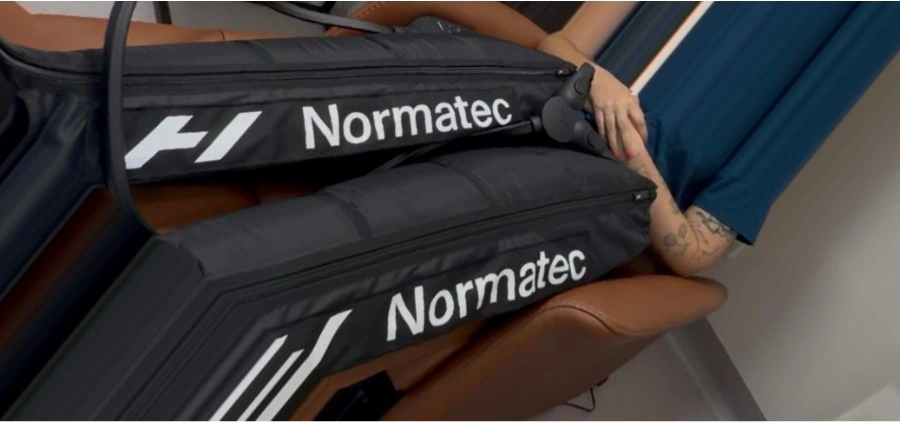
Our lymphatic drainage service uses Normatec, a pneumatic compression system, with attachments for the legs, glutes and arms. It is not manual lymphatic drainage by a practitioner, and it is not lymphoedema treatment. A session runs for 45 minutes of rhythmic compression and release of pressure. Ask the team which attachments suit your goal. A single session is A$50, with packs of five at A$225 and ten at A$399. Check the booking page for current prices.
What the evidence says
The best evidence comes from systematic reviews of controlled trials. Most trials are small, use different exercise protocols and test healthy adults, so treat the findings as early. One more limit: this research is on the legs. The 2024 review looked only at lower-limb compression. Arm and glute attachments are available, but I found no comparable body of evidence for recovery benefit there. If you choose them, treat it as comfort and preference, not proven recovery.
Soreness
This is where the signal is strongest. A 2025 review of 27 studies and 554 healthy adults found a small effect on soreness and pain, but called the overall evidence for recovery inconclusive. A 2024 review of 17 studies found trivial to moderate effects on soreness. In practice, that suggests your legs may feel somewhat less sore. Most studies cannot hide the boots from participants, so expectation may play a part.
Tiredness
Results are mixed. A sham-controlled crossover trial in 16 trained people reported higher perceived recovery after compression, with no change in cycling power output.
Strength recovery
The 2024 review found a trivial to small benefit for muscle function. For an everyday gym member, that is unlikely to change how your next session goes.
Athletic performance
In a controlled trial of 21 trained cyclists, 30 minutes of compression between a 20 minute effort and a 4 minute test gave little added benefit. The 2025 review also found no significant effect on most other outcomes. The reviews also note that many studies used sessions of about 20 to 30 minutes at pressures near 80 mmHg. That describes what researchers used, not a proven best dose. A 45 minute session is longer than most of those protocols, and there is no evidence that longer is better.
Who might consider a session
A recreational runner in a heavy training block or a gym member with a big leg week might find a session pleasant and worth trying. Some people simply like how their legs feel afterwards, and that is a fair reason. Nobody needs paid recovery services. Sleep, protein and total food intake, hydration and sensible training load do far more. If those are off, no device will fix it.
What a first session involves
You will complete a short health screening and a quick consultation before the garments are fitted. Ask when booking what to wear. The sensation is usually a firm, rhythmic squeeze that builds and releases. The service page describes it as gentle pressure and release. It should feel snug, not painful. Tell staff if it feels too tight, and ask which adjustments the device allows. We do not set a universal pressure or schedule, because none has been established. Alert staff straight away for sharp or worsening pain, numbness, pins and needles, cold or colour change in the toes, dizziness or breathlessness. Manufacturers advise stopping use if severe pain or unusual symptoms occur.
Who should avoid compression boots or get advice first
Normatec's manufacturer instructions list conditions where you should see a doctor before using the system, including deep vein thrombosis (a blood clot in a deep vein), past pulmonary embolism, acute thrombophlebitis, acute heart failure, acute infection, wounds or tumours near the application site, and fractures or dislocations near the site. Another major brand, Therabody, also lists severe peripheral artery disease, a pacemaker or ICD, and a recent skin graft or vascular bypass. If you are pregnant, ask the team and your doctor first. Ordinary post-exercise tiredness is both legs feeling heavy and sore after hard training, easing over a day or two. Unexplained swelling is different. Swelling in one leg, especially with pain, warmth or redness, can signal a blood clot. Healthdirect says to see a doctor immediately, and to call 000 for chest pain or trouble breathing. Compression boots are not a way to treat swelling nobody has diagnosed. Get it assessed first.
Marketing claims worth challenging
Detox. The theory is that moving lymph fluid helps the body clear waste, which is why you will see "supports detoxification" in wellness descriptions, including ours. The evidence is a separate matter. The research above measured soreness, fatigue and performance, not detoxification. Your liver and kidneys do the clearing, and the lymphatic system mainly returns fluid and supports immune function. Treat detox as an idea that has not been tested in this setting, not a result you should expect. Fat loss and cellulite. None of this research tested either, so these claims have no support from it. Flushing lactic acid. Lactate generally returns to baseline within about an hour of exercise, well before delayed soreness peaks, and it is not the cause of that soreness. The cyclist trial found an unclear effect on lactate clearance. Injury healing. Not tested here. A suspected injury needs proper assessment from a GP or physio.
How to decide if a session is worth it
Ask three questions. Do you enjoy it? Is the cost reasonable for you? Is your goal realistic? A fair test is to book one session after a hard week. Note how your legs feel over the next 24 to 48 hours and compare that with a similar week without it. If you notice a difference you value, that is your answer. If not, you have lost an hour and A$50, not a year of membership. Repeat sessions are a choice, not a medical need. Combining therapies does not guarantee better results, so add one thing at a time.
Book your first session
Level 1, 284 Bay Road, Cheltenham VIC 3192. Questions before you book? Call 03 9022 6606.
Book at Cryo SubZeroFrequently asked questions
Are compression boots the same as lymphatic drainage massage?
No. Boots use air pressure from a pump. Manual lymphatic drainage is a light hands-on technique from a trained practitioner. Both aim to move fluid, but they are different treatments.
Do compression boots help after running or gym training?
They may modestly reduce perceived soreness. Evidence for strength recovery or next-day performance is limited and inconsistent.
What does a session feel like?
A firm, rhythmic squeeze that builds and releases around the legs. Snug is normal. Pain is not.
How long does a session take?
A session runs for 45 minutes of rhythmic compression and release of pressure.
How often should you use compression boots?
No evidence-based schedule suits everyone. Try one session, watch how your legs feel for two days, then decide.
Who should avoid compression boots?
Anyone with a known or suspected blood clot, acute infection, acute heart failure, wounds or fractures near the treatment area, or unexplained leg swelling or pain should get medical advice first.

Medical disclaimer: This article is general information and not individual medical advice. It does not replace consultation with your GP or treating health professional. Seek advice before starting any new recovery therapy, particularly if you have a heart, circulation, clotting, skin or musculoskeletal condition, or are pregnant. Cryo SubZero staff will complete a health screening before your first session. Persistent pain, unexplained swelling or a suspected injury should be assessed by a qualified health professional.
References
- Maia F, et al. Effects of lower-limb intermittent pneumatic compression on sports recovery: a systematic review and meta-analysis. Biology of Sport 2024;41(4):263275. doi.org/10.5114/biolsport.2024.133665
- From fads to facts: a systematic review and meta-analysis of intermittent pneumatic compression therapy for muscle recovery. Strength and Conditioning Journal 2025;47(4):450-464. doi.org/10.1519/SSC.0000000000000892
- Overmayer RG, Driller MW. Pneumatic compression fails to improve performance recovery in trained cyclists. Int J Sports Physiol Perform 2018;13(4):490-495. doi.org/10.1123/ijspp.2017-0207
- Intermittent sequential pneumatic compression reduces post-exercise hemodilution and enhances perceptual recovery without improving subsequent cycling performance. University of Barcelona repository record. hdl.handle.net/2445/217624
- Hyperice. Safety instructions, Normatec Elite. hyperice.zendesk.com
- Therabody. Precautions and contraindications. therabody.com/pages/precautions
- Healthdirect Australia. Deep vein thrombosis (DVT). healthdirect.gov.au/deep-vein-thrombosis
- RACGP. Lymphoedema guide. racgp.org.au
- Schwane JA, et al. Is lactic acid related to delayed-onset muscle soreness? The Physician and Sportsmedicine 1983;11(3):124-131. Discussed in: pmc.ncbi.nlm.nih.gov/articles/PMC9505902
- Cryo SubZero. Lymphatic drainage service page. cryosubzero.com.au/lymphatic-drainage/